
How to Survive an Online Reputation Crisis
Real corporate cautionary tales reveal the exact moves that separate brands that recover from reputation crises from those that never bounce back.


- Build customer loyalty before a crisis hits so your audience becomes your defenders when it matters.
- Always acknowledge problems directly and honestly — denial or delay makes reputational damage worse.
- Take visible, specific action to address the exact issue that caused the crisis, not just general improvements.
- A strong brand built over time can withstand significant mistakes if customer relationships are maintained.
- Learning from high-profile corporate failures is one of the most effective ways to avoid repeating them.
Every company will face reputation challenges, but how you respond determines whether those challenges damage or strengthen your brand. This article examines real corporate reputation crises from companies like Apple and Exxon to extract practical lessons. By acting promptly, honestly, and proactively, businesses can weather crises and emerge with their reputations intact.
How to Survive an Online Reputation Crisis
-
1
Face problems promptly and honestly
When a crisis hits, address it directly without delay. Attempting to minimize or conceal the issue compounds reputational damage far more than the original mistake. Customers are far more forgiving of the error itself than of a perceived cover-up.
-
2
Cultivate loyal customers before a crisis strikes
Actively build a positive relationship with your customers through community-building and loyalty programs well before any crisis emerges. Loyal customers can become brand evangelists who defend your reputation when it matters most. Apple's ability to weather multiple controversies demonstrates how a strong, pre-existing customer base acts as long-term reputation insurance.
-
3
Take direct, visible action on the specific problem
Tailor your response to the nature of the crisis rather than offering generic apologies. For example, if your company caused an environmental disaster, launch pro-environmental initiatives and publicly fix the internal procedures that led to the incident. Showing the public that you are addressing the root cause — not just the optics — rebuilds trust more effectively.
-
4
Disclose breaches or failures quickly and fully
When a significant incident occurs, such as a data breach, make a public announcement as soon as possible. Delaying disclosure or downplaying the issue dramatically worsens reputational damage, as Target discovered after waiting four days to inform customers of a sixteen-day breach. The sooner you take responsibility, the sooner customers can begin to trust you again.
-
5
Accept accountability and acknowledge uncertainty
Clearly own the problem even when you do not yet have all the answers. Samsung's response to the Galaxy Note 7 crisis demonstrated that acknowledging a fault openly — even without an immediate solution — is more effective than deflecting blame. Transparency about what you know and don't know signals integrity to your audience.
-
6
Strengthen internal processes after a crisis
Use a reputation crisis as a catalyst to overhaul the internal procedures that contributed to the problem. Both Exxon and Target made significant operational and infrastructure improvements following their respective disasters. Communicating these improvements publicly shows stakeholders that the crisis has produced lasting, meaningful change.
-
7
Learn from corporate cautionary tales
Study how major companies like Apple, Exxon, Target, and Samsung handled their reputation crises to identify patterns you can apply to your own organization. Understanding what these companies did right — and wrong — helps you build a proactive crisis response strategy before you need one. No company is immune to a reputation crisis, and preparation is your strongest defense.
- Learn from the mistakes of companies that have weathered reputation-threatening problems to avoid experiencing a reputation crisis.
- Every company makes mistakes. How you fix those mistakes determines whether they make or break you.
- By facing up to mistakes, addressing the concerns of your customers, and taking a proactive approach to solving problems, you can save your reputation.
- It is critical to face up to problems promptly, directly, and honestly.
If your company has never encountered a negative reputation crisis, consider yourself lucky—but don’t consider yourself immune. The history of business and commerce is littered with industry titans who have gone down in the flames of public relations nightmares. It could be argued that the saying “those who don’t learn from history are doomed to repeat it” is even more valid in business than elsewhere.
Consider this article an examination of cautionary tales and example solutions to keep in mind when faced with a company reputation crisis. Learn from their mistakes so you can avoid their reputation pitfalls. Every company makes mistakes, but by facing up to the mistakes, addressing the concerns of your customers, and taking a proactive approach to solving problems, you can emerge with your good corporate reputation intact.
Cautionary Tales of Corporate Reputation Crisis
Gather ’round and hear these tales from corporate giants who faced threats to their corporate reputations. Some were undone by greed, others by hubris, but the most important thing is how they acted, adjusted, and transformed to rebuild their reputation.
Apple
While they’re known for having a loyal fanbase of customers, Apple has had a few significant reputation disasters that have shaken them significantly:
- After claiming there were no issues with the iPhone 6 bending, Apple acknowledged that they were aware of the problem ahead of time, leading to a class-action lawsuit.
- Apple rejected apps from their app store based on ties to Apple competitors.
- They put a faulty camera lens on the iPhone X that requires expensive repairs.
- They throttled older phones, supposedly to prevent unexpected shutdowns, but potentially in the service of planned obsolescence.
That would be a hefty list for multiple companies, let alone one. Yet, even amid those class-action lawsuits, Apple managed to win the CMO Survey Award for Marketing Excellence for ten consecutive years—a remarkable testament to the durability of a well-cultivated brand.
How did they do that? What did they do right?
Get a Free Reputation Assessment
Find out what people see when they search for you online. No obligation — results in 24 hours.
Apple has long cultivated an extremely loyal customer base who use a variety of products in the Apple ecosystem. They developed that loyalty—and leveraged it—by attending to and nurturing this vital group. By maintaining customers as brand ambassadors and evangelists, Apple has made maintaining their corporate reputation that much easier.
Takeaway: Actively cultivating a positive relationship with your customers can turn them into brand evangelists.
Exxon
Exxon was responsible for one of the worst environmental disasters in history with the 1989 Exxon Valdez oil spill. For years, focus groups found that the first word people associated with Exxon was “Valdez.” They responded internally by organizing and strengthening their procedures for any action at the company, big or small. While their operational improvements did make the news in the years that followed, the Valdez disaster has never fully faded from the public’s memory—particularly as ExxonMobil has continued to face scrutiny over climate-related controversies in the decades since.
Takeaway: Show your public that you are directly addressing the specific problem (e.g., if you create an environmental disaster, launch pro-environmental programs and fix your internal procedures).
Target
Target had a customer data breach that lasted sixteen days before being discovered, with a public announcement following four days later. At the time of the 2013 incident, it was among the largest retail data breaches on record—a distinction that has since been eclipsed by far larger breaches at companies like Yahoo, Marriott, and others. While Target faced criticism for the time it took to inform customers (and for early attempts to minimize the issue), the company ultimately acknowledged the problem publicly and took steps to address it. After a class-action lawsuit, Target agreed to pay up to $10,000 to individual consumers affected by the breach, with the company’s total costs—including settlements, legal fees, and security upgrades—ultimately exceeding $290 million. From there, the company took a number of internal steps to significantly improve its IT security infrastructure.
Takeaway: The sooner you take responsibility and action, the sooner your customers will trust you again.

Is Your Brand Ready for a Reputation Crisis?
Don't wait for a crisis to find out your reputation is vulnerable. RepX helps companies build resilience, monitor threats, and respond effectively before damage spreads.
Samsung
The Galaxy Note 7 from Samsung should have been a profitable product, but quickly turned into a nightmare.
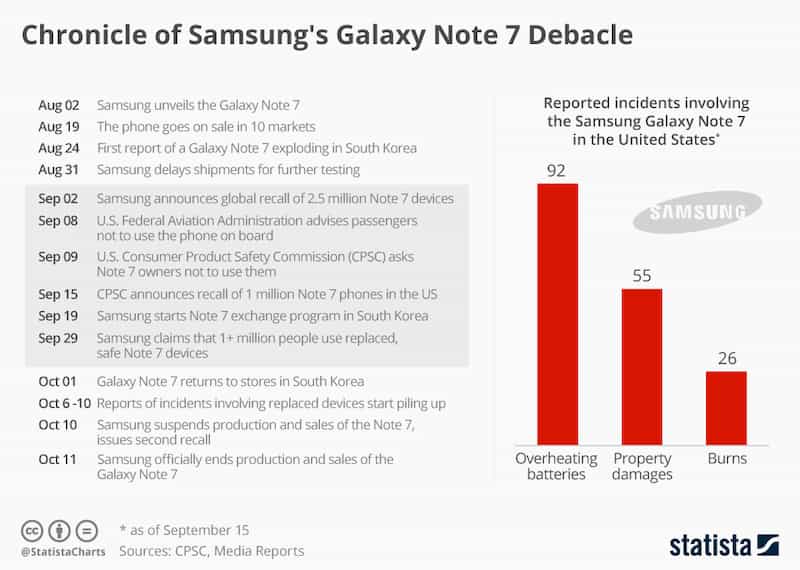
The flagship phones were not just defective, they were potentially dangerous: they exploded or caught fire due to a battery malfunction. The company not only became unprofitable, but it also unwittingly became a popular meme.

Samsung quickly took responsibility for the problem and acknowledged openly that they didn’t yet know what was causing it. Then they proactively attacked the issue, deploying hundreds of engineers and third-party auditors across a wide range of testing scenarios. Once Samsung identified and resolved the problem, they announced their findings publicly and implemented a quality assurance program that included an eight-point battery safety check. They followed this by strengthening their brand unity and actively monitoring and responding to negative feedback.
Takeaway: Take responsibility and address problems honestly—even if it means financial loss—to save your long-term corporate value.
Audi
In the 1980s, a number of Audis were reported to suddenly accelerate backward out of garages and parking lots. This attracted widespread media attention, most notably a 60 Minutes exposé that included a dramatic on-air demonstration of the problem. Audi sales fell over several years, even after it was discovered that the 60 Minutes demonstration had been staged.
The problem turned out to be driver error. Drivers were mistakenly hitting the accelerator instead of the brake. Instead of blaming their customers—thus possibly alienating them and losing them forever—Audi weathered the storm. By being patient and letting the truth come out rather than going on the offensive, they survived. By the time they introduced popular vehicles like the A4 in the mid-1990s, their fortunes had reversed, and they rebuilt their corporate reputation.
Takeaway: Don’t blame your customers, improve your products, stand by the truth.
Key Lessons for Surviving a Reputation Crisis
The companies above span different industries and different eras, but the patterns in how they handled—or mishandled—their crises are strikingly consistent. Whether you’re dealing with a product defect, a data breach, or an environmental disaster, the core principles of effective crisis management remain the same: act quickly, communicate honestly, and take visible corrective action.
Understanding the difference between proactive and reactive reputation management is essential. Companies that had already built goodwill—like Apple—had a buffer that others lacked. Those that delayed or minimized their response—like Target in its early communications—paid a steeper price in both dollars and trust. And those that stayed the course and let the truth emerge, like Audi, demonstrated that patience and integrity can outlast even a media firestorm.
If your organization hasn’t yet conducted a reputation audit or developed a crisis response plan, these cautionary tales make a compelling case for doing so before you need one.
Frequently Asked Questions









Protect Your Online Reputation
Every day you wait, negative content gets stronger. Talk to our experts about a custom strategy for your situation.
Get Your Free Analysis