
Content Structures that Can Amplify Online Visibility
Learn how strategic content formatting, smart publishing choices, and technical enhancements can make your content stand out in competitive search results.


- Publish on topically relevant sites with high Domain Authority for maximum search impact
- Always include your branded search term in the page title tag and H1 headline
- Cross-reference Domain Authority with Ahrefs DR and Semrush Authority Score before publishing
- Optimize your first paragraph and meta description to improve click-through rates
- Use rich media, schema markup, and bullet lists to boost dwell time and search visibility
This article outlines nine structural and technical methods to improve content visibility in search results without relying solely on traditional SEO. Key factors include publishing on high-authority, topically relevant sites and carefully crafting titles, headlines, and first paragraphs. Additional techniques such as rich media, schema markup, bullet formatting, and quality backlinks further strengthen search performance for branded content.
How to Structure Content for Maximum Online Visibility
-
1
Publish on high-authority, relevant websites
Choose websites that are topically relevant to your industry or brand, as relevance is a key factor in how well content ranks. Site strength also matters — use tools like MozBar, Ahrefs Domain Rating, or Semrush Authority Score to evaluate Domain Authority before publishing. Aim for sites with high authority scores, but always prioritize topical relevance over raw authority numbers.
-
2
Optimize your page title with branded terms
Include your branded search term in the HTML title tag, which appears in browser tabs and search result listings. Search engines treat the title tag as a strong relevance signal, so place your brand name prominently within it. Be aware that Google may rewrite titles based on on-page content like H1 tags, so ensure your on-page content is also well-optimized.
-
3
Structure headlines with primary and secondary terms
Use H1, H2, and H3 headline tags to create a clear information hierarchy that tells both readers and search engines what is most important on the page. Embed your branded terms naturally across multiple headline levels throughout the article. This nested structure helps search engines understand the depth and relevance of your content.
-
4
Write compelling, honest headlines
Draw inspiration from clickbait techniques to make headlines genuinely enticing and hard to ignore, without being misleading. Your headline's sole job is to earn the click, but the content must deliver on whatever promise the headline makes. A misleading headline increases bounce rate, which search engines like Google track as a negative signal.
-
5
Craft a strong meta description
Write a description that persuades searchers to click through to your content rather than a competitor's result. While descriptions carry limited direct SEO weight, they significantly influence click-through rates from search result pages. Make the description accurate, engaging, and reflective of what the reader will actually find on the page.
-
6
Front-load your first paragraph with key information
The opening paragraph is heavily weighted by both readers and search engines, so include your most important branded terms and context early. Use it to immediately signal what the page is about and why it matters to the reader. A strong first paragraph reduces bounce rate by confirming to visitors that they have landed on the right page.
-
7
Aim for longer content with scannable formatting
Longer articles tend to rank better because they signal depth and thoroughness to search engines. Break up your content using bullet points and numbered lists to improve readability and help readers find information quickly. Scannable formatting keeps readers on the page longer, which positively influences how search engines assess your content's quality.
-
8
Add rich media and schema markup
Incorporate images, videos, or interactive elements to increase the amount of time visitors spend on your page, known as dwell time. Higher dwell time signals to search engines that your content is valuable and relevant. Adding schema markup to your HTML further helps search engines understand your content and can earn rich result features in Google and Bing.
TLDR
No time to read this? Here is a synopsis: Using these nine methods, you can enhance content ranking without traditional SEO. Publish on topically relevant, high-authority websites and use strong, branded titles and headlines. Optimize the first paragraph and descriptions to engage readers. Aim for longer articles and use bullet points for readability. Incorporate rich media to increase dwell time and add schema markup for better search engine visibility. Finally, build quality backlinks to improve ranking and credibility, ensuring your content stands out in search results.
Top things to do to make content more visible in search:
- Publish on the right website
- Choose the right title
- Technical and psychological/clickbait headlines
- The Description gets people to click
- The first paragraph is important
- Page length advice
- Bullets and numbered lists (like this one)
- How rich media increases dwell-time
- Add “schema” to your HTML to get rich results in Google and Bing
Where content is published is key
When you want an article to rank well in search results for a branded search phrase, the place you publish the article matters.
Look for the following when choosing where to publish your content:
- Is it topically relevant?
- Is it industry-related?
- Who is the website publisher?
- What is the Domain Authority of the website?
The ideal location for an article is on a site that is topically relevant to the entity being written about. For example, if your industry is manufacturing, a good place to post would be a website about manufacturing. If your brand is an automobile manufacturer, a site specifically about automobile manufacturing is the best choice.
Topical relevance matters, but so does site strength. One of the most common ways to measure site strength is Domain Authority — a scale of one to one hundred where higher numbers indicate greater strength. The objective is to publish on topically relevant websites with the highest possible Domain Authority.
A website with a domain authority of 80 is far more powerful in search results than one with a domain authority of 20. You can measure domain authority using tools like the MozBar SEO Toolbar Chrome extension. Competing metrics such as Ahrefs’ Domain Rating (DR) and Semrush’s Authority Score are also widely used alternatives worth exploring.
Get a Free Reputation Assessment
Find out what people see when they search for you online. No obligation — results in 24 hours.
The title and headline of the page
When creating branded content intended to rank well in search results, use the branded search term in the title of the webpage. The title appears in the browser tab and, traditionally, at the top of each search result. It is not the same as the Headline (more on that below).
Google and other search engines use the title tag as a strong relevance signal. Since 2021, Google has frequently rewritten page titles in search results based on on-page content such as H1 tags and anchor text — meaning what you write may not always be what searchers see. That said, the title tag remains an important signal and is still worth optimizing carefully.
This is what the title of a webpage looks like in HTML:
<title>Example</title>
If the name of your branded entity is Blue Widgets Incorporated, you would want the words “Blue Widgets Incorporated” in the title of the webpage.
The headline is the second most important
The Headline is the largest text at the top of an article. Headlines are classified as H1, H2, H3, and so on. An H1 is the most important, with H2 nested within it and H3 nested within H2. They provide an information hierarchy that tells both people and search engines what is most important on the page.
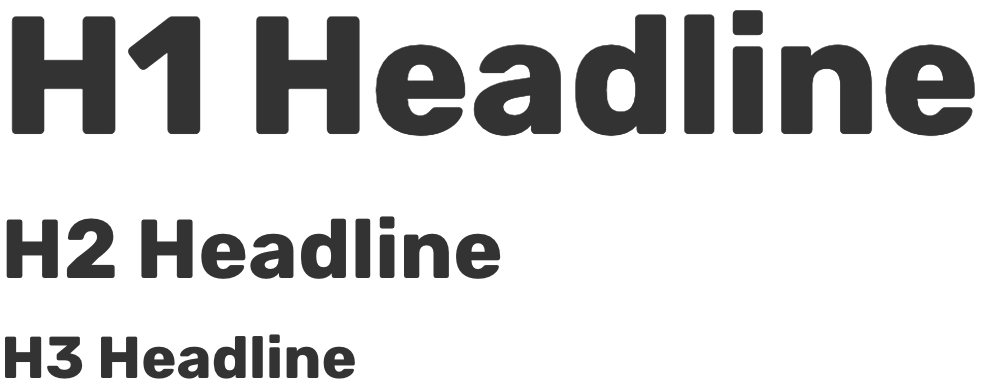
Headlines should contain primary, secondary, and tertiary search terms. For example, if your brand is Blue Widgets Incorporated and you want the article to rank well for that brand, your page headlines might look like this:
Blue Widget Inc. Saves Kitten from TreeThe good folks at Blue Widget saved a kitten from a tree today using their new Feline Rescuometer. The kitten had been stuck in the tree for two weeks! Thanks to the… The Origin of the Blue Widget Feline Rescu-o-meterThe Feline Rescu-o-meter was the brainchild of Blue Widget founder Kent Campbell. One day while walking his cat, Mr. Campbell heard mewling from high in a eucalyptus tree. He looked up and noticed a kitten high above – but he had no way to reach it. So he went to his garage and began work. Two weeks later he returned to the tree with the Feline Rescu-o-meter and rescued the poor starving animal… How to Build Your Own Rescu-o-meterThe first step is to get a long stick… |
Clickbait headlines should be an influence, not a rule
A “clickbait” headline is one that seems almost irresistible to click. Examples include:
- This Is Why You Shouldn’t Try To Outrun A Bear
- This Is What Happens After You Die
- Does It Drink the Blood of Its Enemies?
A headline is like a direct-mail envelope — its only job is to get people to click. While we aren’t suggesting you go full-clickbait, think about what you can do to make people genuinely want to click. For a deeper look at how clickbait psychology works, see our post on clickbait examples and headline tactics.
The problem with clickbait headlines is alignment. If the headline does not match what the reader finds on the page, they will click back to search results — resulting in a bounce. You may get high volume, but low interaction, and Google notices this pattern.
The description also gets people to click
The description carries little weight for search engine optimization purposes because search engines pay little attention to it — but it is still important as a way to get people to click on your article.
When people scan search results, they see a headline and a short snippet below it. That snippet is usually pulled from the description you write, though research suggests Google rewrites or ignores the provided meta description roughly 60–70% of the time, substituting its own version based on page content. You should still write a strong description, but don’t count on it appearing verbatim.
The description and the headline together “sell” your article to the person browsing. When you perform a search, you scan results looking for the best fit — reading the headline and the snippet below it before deciding which result to click. The description you create is what motivates people to choose your result over someone else’s.

The description should always include the branded search phrase so people can identify it as relevant to their query. If the snippet contains the phrase they are searching for, they are more likely to click it.
of the time, Google rewrites or ignores the meta description you provide
Industry Research
The first paragraph tells people and search engines a lot
The first paragraph of any article — whether on your own site or someone else’s — should summarize the content so people quickly know whether they want to keep reading.
It is also important that the first paragraph include any secondary search phrases. For example, if your company is Blue Widgets Incorporated and you want the article to rank for that phrase, include it in the first paragraph where it reads naturally. A secondary phrase such as “Blue Widget Incorporated reviews” can also support the primary one. The first paragraph t
Frequently Asked Questions








Protect Your Online Reputation
Every day you wait, negative content gets stronger. Talk to our experts about a custom strategy for your situation.
Get Your Free Analysis