
Fact-Checking Fake News Today
Fake news has evolved far beyond simple false stories — here's how to recognize manipulation tactics, spot unreliable sources, and find verified facts.


- Fake news examples: Where does fake news live?.
- Fake news sites.
- Imposter sites.
- Real content, wrong context.
- Fake information.
Has any phrase been more divisive and frustrating during the election cycle and current federal administration than “fake news”? Fake news—who makes it, who reads it, who believes it, and who profits from it—are all increasingly important topics in modern society, so much so that it now seems Americans live in two separate, competing realities. In today’s stringently bipartisan media, supporters on both sides have no problem decrying the other for producing “fake” news or news ungrounded in verified facts.
Has any phrase been more divisive and frustrating during the election cycle and current federal administration than “fake news”? Seemingly innocent in its phrasing, the term has come to stand for entirely more than just a story with false facts.
Fake news—who makes it, who reads it, who believes it, and who profits from it—are all increasingly important topics in modern society, so much so that it now seems Americans live in two separate, competing realities.
In today’s stringently bipartisan media, supporters on both sides have no problem decrying the other for producing “fake” news or news ungrounded in verified facts. Careers have been built and sustained by fake news, from the Obama birther conspiracy to unsubstantiated claims of voter fraud. With the rising power of “alternative truths,” fake news seems destined to remain relevant to internet users and media consumers everywhere. So how do you get the facts, and how do you know them when you see them?
Fake News Examples: Where Does Fake News Live?
Fake news isn’t new. False information has always abounded but hasn’t always held so much sway over public policy. Fake news can be broken down into several distinct types, all of which appeared prominently during the 2016 election cycle and have only grown more prevalent through the 2020 and 2024 election cycles since.
Fake News Sites
Take a look at some of the fake stories that have gone viral, and you’ll notice that many of them have one major thing in common: the news sites they’re coming from are also fake. Just like spam emails, news stories from fake sites may look real on a superficial level, but their content is anything but legitimate. During the final three months of the 2016 presidential campaign, engagement with fake news sites skyrocketed, surpassing engagement with legitimate media.
According to a report by NPR, a single city in Macedonia was once home to more than 100 fake news sites, with owners openly admitting that advertising revenue was the primary driver. But the phenomenon has since evolved far beyond that early example. Subsequent reporting by the BBC, Wired, and others revealed a much more complex global landscape — one that now includes coordinated inauthentic behavior networks spanning dozens of countries, as well as state-sponsored disinformation campaigns operating at scale. In short, the commercially motivated Macedonian model was just the beginning.
Imposter Sites
The difference between broadly categorized fake news sites and imposter sites is that imposter sites take the extra step of trying to appear legitimate. Anyone who looks closely would know that “abc.com.co” is not the same as abc.com, but those who believe it often aren’t the ones looking closely.
Get a Free Reputation Assessment
Find out what people see when they search for you online. No obligation — results in 24 hours.
Real Content, Wrong Context
A picture can say a thousand words, and with fake news, those words can be anything you want. One popular video from the election cycle infuriated Trump supporters by showing ballot box stuffing in an American voting facility. The problem? The video was taken in Russia.
Fake Information
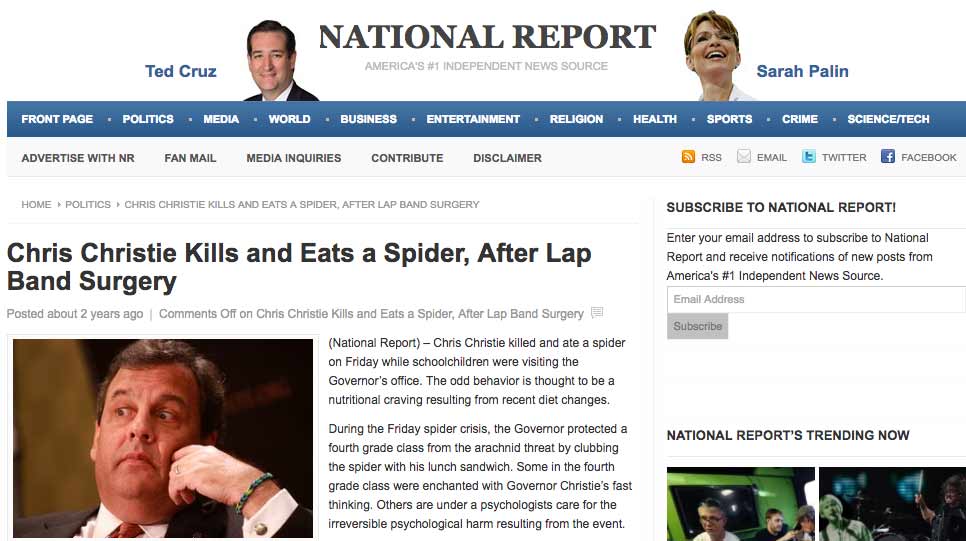
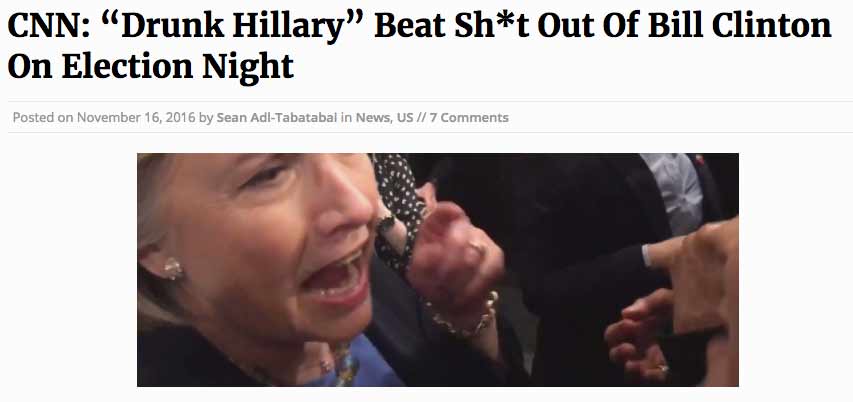
Anyone can make up a fact, attach it to a graphic, and spread it around. Despite a lack of grounding, these memes can—and do—disseminate quickly. They’re easily digestible, easily shareable, and have often gone viral long before they’re disproven.
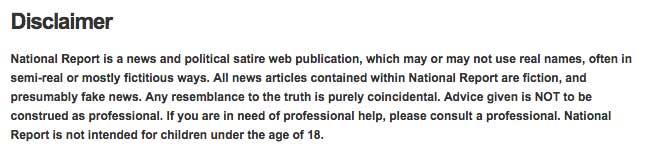
Some sites even include a disclaimer about their fake news content.
Manipulated Content
Those all across the political spectrum were quick to accuse others of manipulating images that showed the crowd size at Trump’s 2017 inauguration. Trump supporters (and Trump himself) claimed that the sparse crowds were a result of liberal tampering. However, aerial photography, time-lapse video, and Metro ridership data were subsequently cited by fact-checkers at PolitiFact and FactCheck.org as providing objective evidence that the crowd was smaller than the one that attended the 2009 Obama inauguration.
Dark PR Agencies
There are entire agencies committed to the darker methods of public relations, and they’re not always state actors. This article goes into more detail about dark PR and reputation manipulation.
Why Fake News Matters
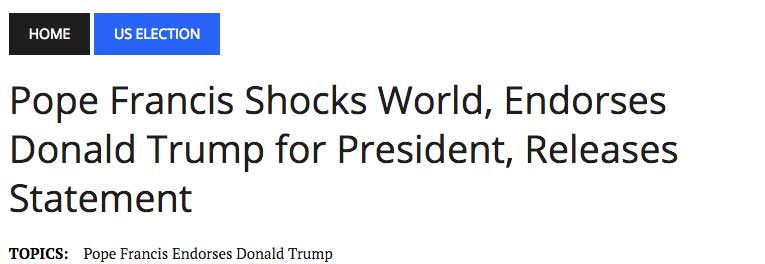
Fake news serves a very distinct purpose—to contribute to an agenda that otherwise has no backing. For example, the viral (and completely fake) story of the Pope voicing support for Trump was intended to lend more legitimacy to Trump’s campaign and bring Catholics on board.
In another example, a widely shared meme that appeared to come from Hillary Clinton’s campaign falsely claimed that voters could cast their ballot by text message from home. This was intended to keep Clinton supporters away from the polls.
Silly as these attempts are, they spread misinformation and, in the case of fake election news, most likely convinced some people that certain falsehoods were true. Fake news matters because it serves as fuel to support ideas that otherwise have no standing. It’s also corrosive, taking away legitimacy from real news sites simply because people refuse to believe the story they don’t want to hear is the story that’s grounded in truth. It depletes the power of real facts, pandering to an infantile desire to hear what one wants to hear and block out the rest.
The Role of Social Media in Spreading Fake News
As fake news has become more pervasive, so too has the general understanding of the mischief it can cause. As a result, there have been widespread calls for platforms like Facebook and X (formerly Twitter) to do more to monitor the spread of misinformation. Those calls have met with mixed results: Meta ended its U.S. third-party fact-checking program in January 2025, and X substantially reduced its trust and safety operations following its 2022 acquisition. The platforms that were once pressured to do more are, in many respects, now doing less.
Facebook in particular received significant condemnation during the 2016 election cycle for allowing fake news to spread freely. Many Americans rely on Facebook as their primary media source, so it’s not an exaggeration to say that the platform does real harm when it allows fake news to infiltrate newsfeeds. Since then, Meta has cycled through various fact-checking and content moderation policies — only to roll back many of them by early 2025, leaving the platform’s role in curbing misinformation more uncertain than ever.
Social media plays two distinct roles in the spread of fake news. Personal accounts allow users to post what they want, regardless of accuracy.
These personal posts matter less than the media sites—real and fake—that publish and amplify false stories. If your Aunt Mary claims three million people voted illegally, you’ll probably require more evidence before you believe her. If a news agency makes the same claim with fabricated proof and a polished presentation, algorithms will spread it directly to the people most primed to believe it.
According to Pew Research Center data from 2024, approximately 50% of U.S. adults report getting news from social media at least sometimes, with YouTube, Facebook, and Instagram among the top platforms. That share has grown substantially since 2016, making the role of algorithms in amplifying misinformation more consequential than ever. Those algorithms divide up content such that fake stories tend to reach the people most primed to believe them.
These stories tend to be provocative and eminently shareable, spreading rapidly among audiences hungry for confirmation of their existing worldview.
Is Fake News Hurting Your Reputation?
Misinformation spreads fast. Our team can help you monitor, respond to, and suppress false narratives before they cause lasting damage.
How to Fact-Check Fake News
Fact-checking is an important part of media and a longstanding practice within good journalism. It’s necessary to attach integrity to a news story, assuring the reader that the writer, editor, and publication have done their due diligence in efforts to tell a true story.
Fake news, however, puts the onus on the reader. So how do you know what’s real and what’s fake? There are a few things you can and should do to separate the truth from the fiction.
Consider the Source
A lot of fake news comes from fake sites. You’ll have to go deeper than a social media post to spot a fake site. Investigate the sources of links by searching the news agencies online, looking at their “About” pages, and looking at who else is sharing their content. Some sites are much easier to spot as fake than others. The Media Bias/Fact Check database and the Duke Reporters’ Lab fact-checker index are actively maintained resources that can help you assess the credibility of a source.
Look Past the Headline
It’s easy to write a punchy headline appealing to a certain demographic, but if the facts aren’t there, there’s not going to be much substance behind it. If you see a headline that looks suspicious, click on it. What evidence is being used in support of its claim? The Obama birther rumors persisted for years without any actual proof because easily shareable snippets perpetuated the claim, not because it had facts to support it.
Investigate Sources
Social media has given a voice to everybody, but it hasn’t bestowed legitimacy. If an article’s source is an X (formerly Twitter) handle instead of a real person, or it’s someone who has vocally supported other false claims, their bias and lack of standing will tell you something about the news item as a whole.
Check Your Own Biases
If something sounds too good (or crazy or evil) to be true, it very likely might be. Be as willing to accept facts that go against what you want to hear as facts that support your beliefs. News shouldn’t feed your personal confirmation bias—it should tell us the truth about what’s going on.
Refer to Established Fact-Checkers
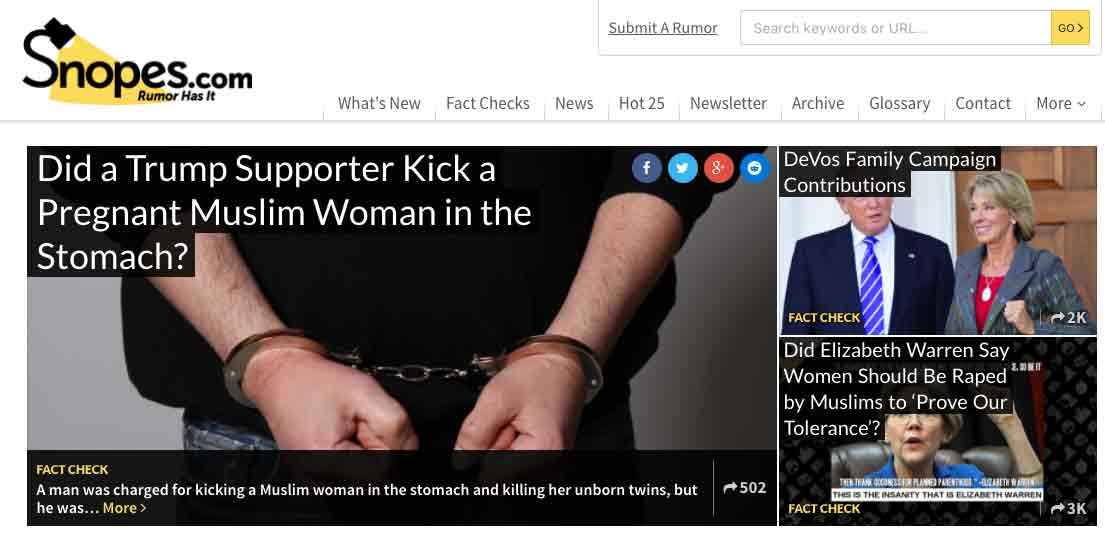
Sites like FactCheck.org, Snopes.com, PolitiFact.com, the Washington Post Fact Checker, AP Fact Check, and Reuters Fact Check often do the dirty work for you, investigating claims against their experts and sources and letting you know what you should believe and what you should ignore.
Learning how to fact-check what you read has never been more important. The challenge has only grown since the rise of AI-generated content, deepfakes, and large language model-produced misinformation — new vectors for fake news that didn’t exist at scale just a few years ago. When misinformation targets a person or brand, the consequences can be severe; understanding how to suppress negative news articles and navigate a reputation crisis becomes just as essential as spotting the fake story in the first place. Always remain skeptical, and never assume fake news will self-destruct on its own. It’s up to those who honor truth to limit the power of fake news to rule the internet.
Frequently Asked Questions








Protect Your Online Reputation
Every day you wait, negative content gets stronger. Talk to our experts about a custom strategy for your situation.
Get Your Free Analysis