
Link Equity Explained: What It Is and How It Is Calculated
Master the principles behind link equity — from the original PageRank algorithm to today's 11 ranking factors — and build a backlink profile that earns lasting authority.


- Prioritize link quality over quantity — one authoritative link outperforms dozens of low-quality ones.
- External links from other websites carry more equity than internal links from your own site.
- Google's PageRank algorithm is still active and influences how link equity flows between pages.
- Internal linking strategies help distribute link equity across your entire website.
- Link equity is shaped by factors including source quality, relevance, and link placement on the page.
Link equity measures the value a link passes from one webpage to another and is a foundational concept in SEO. Originally rooted in Google's PageRank algorithm, link equity has evolved from simple link counting to a nuanced system based on quality, relevance, and placement. This article breaks down 11 factors Google uses to calculate link equity and explains how to apply them to build a stronger backlink profile.
Link-building campaigns are a key tenet of every successful SEO strategy. To build authority and earn the respect of search engines, your website needs high-quality links from high-quality websites.
After all, links are still the currency of the internet, and link equity is a big part of what makes them valuable. But what exactly is link equity? And why do some links offer more benefits than others?
This article details the basics of link equity, how it has evolved, and how it is currently calculated. To craft a content development process and an effective outreach campaign that generates powerful links, be sure to master these principles of link equity for a scalable content development program.
What Is Link Equity?
Link equity is a measure of the value that a link passes from one webpage to another. Sometimes referred to as “link juice” or “link authority,” link equity is determined by several factors, including:
- The quality of the linking website
- The relevancy of the link to the destination page
- The location of the link
Understanding the flow of equity and authority between websites is important for link-building and driving blog traffic. To improve your backlink profile and help your website rank higher in search results, optimize your links for all 11 link equity factors listed below.
The PageRank Algorithm and Link Equity
The original PageRank algorithm was developed in 1998 and named after Google co-founder Larry Page. The iterative approach to determining the value of a webpage relied on two key factors:
- A page was deemed important if it was widely linked to by other pages.
- The network of links between pages passed link equity through the system, similar to the way water flows downstream through pipes or rivers.
PageRank scores webpages on a scale from 0 to 10. Initially, this information was publicly available in the Google Toolbar. The underlying data was no longer updated publicly after 2012, and the metric was discontinued entirely in 2016. Google still uses PageRank as part of a large suite of ranking factors.
The 2024 Google API Content Warehouse leak further corroborated this, confirming that PageRank-like signals remain active in Google’s ranking systems. It also revealed additional link-related signals that had never been publicly disclosed.
To combat link spamming in blog comments, directories, and link farms, Google has repeatedly updated its link-valuation algorithm. As a result, link equity has shifted from a simple link-counting exercise to a nuanced system that considers many different factors. In short, link equity is more about link quality than link quantity. This shift mirrors broader trends in SEO reputation management, where sustainable authority-building matters far more than short-term tactics.
Get a Free Reputation Assessment
Find out what people see when they search for you online. No obligation — results in 24 hours.
11 Ways Google Calculates Link Equity
To determine the quality of a link, Google and other search engines evaluate several factors. Here are 11 link equity factors known to influence the value a link passes to another page:
External vs. Internal Links
External links from other websites offer more link equity than internal links from your own website. External links signal trust and authority, while internal links are viewed primarily as a navigation tool.
That said, internal linking strategies are still crucial for optimizing the flow of value. By carefully linking to related pages, you can ensure that link equity is spread throughout your entire website. Without external validation, however, it is much more difficult to build organic visibility.
Interior Pages vs. Home Pages
Home pages are the most linked-to pages on the internet, giving them an edge in passing link equity. For receiving link equity, it is best to earn links to interior pages that still need to build authority.
To get the most from an incoming link, point it to a deep page on your website rather than your home page. This helps prevent your site from becoming too “top heavy” in its link distribution.
Domain and Page Authority
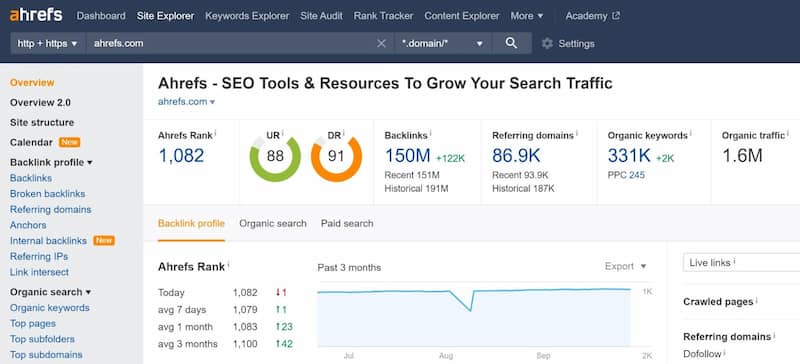
Links from websites with high domain authority generally pass more link equity than links from low-authority websites. Similarly, links from high-authority individual pages are more valuable than those from low-authority pages.
Domain authority measures the link strength of an entire website, while URL authority measures link strength at the individual page level. Both scores range from 0 to 100 and are used to predict how well a website will rank in search results. They are determined by:
- The backlink profile
- Content quality
- Domain age
- Website size
To check the authority of a linking website, use tools such as Ahrefs, Moz, or Semrush. Keep in mind that these estimates vary between tools because they are proxies for the internal calculations used by search engines.
Topical Relevancy
Search engines recognize that every website has a distinct sphere of influence. For a link to lend credibility, the linking content should be relevant to your niche.
For example, a link from a marketing website passes meaningful link equity to an SEO company. A link from a travel blog, however, offers little value to a financial services business. The travel blog has not established the reputation necessary to influence rankings in the world of finance.
Link Diversity
Earning a link from a new domain is more valuable than receiving another link from a domain that already links to you. Each link from a new domain expands your link network and increases your total link equity.
For this reason, track not just the number of backlinks you build but also the number of unique referring domains. Understanding anchor text diversity is equally important when building a natural-looking link profile. Link quality still outweighs link quantity, but all else equal, diversifying your link relationships is the right approach.
Anchor Text
Anchor text is the clickable phrase used to link one page to another. According to Google representatives, anchor text does offer helpful context when evaluating links.
Ahrefs conducted a study of nearly 400,000 web pages to investigate the impact of anchor text on keyword rankings. The findings showed a weak but marginally positive correlation between exact anchor text matches and rankings.
Descriptive anchor text may offer some SEO benefit, but over-optimizing for exact keyword matches is risky. Google’s link spam updates have made aggressive anchor text optimization an increasingly reliable red flag for search quality reviewers.
Build a Link Profile That Lasts
Link equity is only one piece of a comprehensive SEO and reputation strategy. Our team can help you build sustainable authority that stands up to algorithm changes.
Follow vs. Nofollow Links
Nofollow links carry a rel=”nofollow” attribute in their HTML. Originally, this tag instructed search engines not to pass equity through the link. Since 2019, however, Google treats rel=”nofollow” as a “hint” rather than a strict directive, meaning Google may still crawl and pass equity through nofollow links at its discretion.
Google also introduced two additional link attributes in 2019: rel=”sponsored” for paid or affiliate links, and rel=”ugc” for user-generated content such as comments and forum posts. Follow links — those without these attributes — do contribute to SEO by passing link equity. Even so, a followed link does not guarantee SEO benefits, and a nofollowed link can still deliver value through brand awareness and referral traffic.
Link Crawlability
Search engines can be directed not to crawl and index certain pages via a robots.txt file. When this is the case, all links on those pages are ignored and considered dead. Dead links do not pass link equity.
To check whether a link is live and crawlable, use a tool such as Dead Link Checker or Sitechecker.pro. These tools help you surface dead links so you can take action to reclaim them. Creating a sitemap and removing any NoIndex tags will also help your own pages rank better.
HTTPS and Redirect Status
Google maintains that 301 redirects retain their link equity, including redirects from HTTP to HTTPS. Google’s John Mueller has also clarified that 302 redirects pass PageRank equivalently — a nuance worth keeping in mind when managing site migrations. Redirecting irrelevant links from a purchased domain to your home page, however, is unlikely to provide any link equity benefit.
Link Location on the Page
Where a link appears on a webpage influences how much equity it passes. Links in the footer or sidebar are generally less valuable than links in the main body content.
Footer and sidebar links tend to be less visible to users and are less likely to be clicked. This reduced interaction limits their ability to pass link equity. For the same reason, links placed higher in the body content are often more valuable than those buried lower down or placed in an author bio.
Number of Links on the Page
The total available link equity from a page is split among all the links it contains. This is why tactics like link farms — where hundreds or thousands of links are added to a single page — are ineffective.
The same principle applies to highly authoritative social media platforms. Because these sites apply nofollow or ugc attributes to user-generated links by default and carry billions of outgoing links, the equity passed from any single social media link is effectively zero.
Final Thoughts on Link Equity
Link equity is a complex part of SEO, and its calculation is not fully transparent. By understanding the factors that influence link equity, you can make better decisions about link building and link placement.
The evolution of link equity — from its original PageRank days to the current landscape — points in a clear direction. Google’s helpful content system, refined through multiple updates and folded into the core ranking algorithm as of the March 2024 core update, makes clear that websites should focus on people-first content.
Rather than exploiting temporary loopholes, focus on building a link profile that will stand the test of time. By creating genuinely valuable content and linking naturally, your website will maximize its link equity and long-term visibility. For a broader view of how these principles apply to brand visibility, see our guide on link building for SEO reputation campaigns.
Frequently Asked Questions








Protect Your Online Reputation
Every day you wait, negative content gets stronger. Talk to our experts about a custom strategy for your situation.
Get Your Free Analysis